
This is not a piece about music. Take the hymnal out of the room and what is left is the actual subject: strangers, no shared training beyond a notation system, producing something coordinated and whole with nobody standing at the front for longer than one song. A brand guideline is trying to solve the identical problem, two centuries later, in a Figma file instead of a hollow square. How do you get people who never met the founder to still sound like the founder?
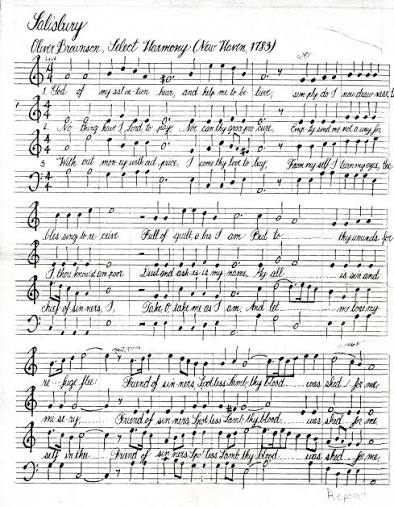
On a Sunday in rural Georgia, forty people who have never rehearsed together sit in a hollow square, facing inward, and sing. Nobody stands at the front. Someone gets up, walks to the center, picks a song, beats time with one hand, and sits back down four minutes later. Then someone else does. There is no choir director. There has never been a choir director. This is Sacred Harp singing, and it has worked exactly this way for over two hundred years.
Every coordination system ever built for strangers is answering one question, and the same question every time: how do you make the person at the center optional, without losing what they knew? Design systems did not start as a discipline. They started as a workaround, and the workaround is two hundred years old.
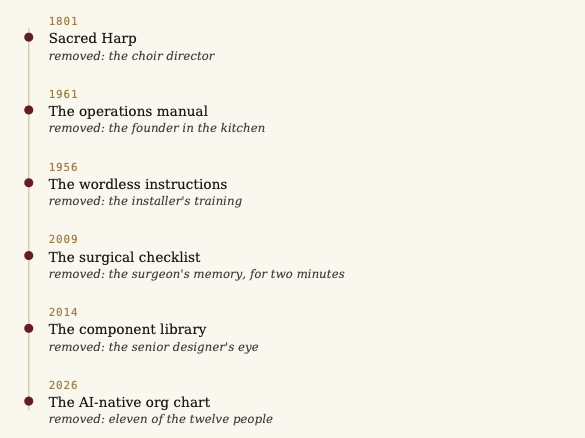
Exhibit · Three systems that wrote someone out


Every one of these systems was built by someone with nothing personal to protect inside it, which is exactly what let them build a system that did not need protecting.
“The system was never built to prove someone was needed. It was built to prove nobody had to be, and that turned out to be the whole point.”
Say this to a creative director in 2026 and you will get an argument worth having, because it is not entirely true. The title has not simply gone hollow. Design automation is now handling most of the production work across the industry's own tools, and the senior end of the role is shifting toward AI direction and brand governance rather than disappearing outright. What the design system removed was not the person. It was the decade of apprenticeship that used to sit underneath the title, the years a junior spent making a thousand small, forgettable, expensive mistakes on someone else's budget until their eye was worth trusting. The eye still gets trusted. There are fewer rooms left where anyone can go earn one.
Publishing worked out a milder version of this before software existed. A style guide, an AP Stylebook, a Chicago Manual, lets four hundred bylines read like one publication without a single copy chief reading every sentence that runs. The design system did not invent the idea of writing yourself out of the room. It just got faster at it, and started doing it on purpose instead of by accident.
I will admit the uncomfortable part, because writing this without it would make the whole argument sound cleaner than it feels from where I sit. I run an agency that gets hired, in part, to build exactly these systems for other people's brands. There is a small, real temptation, on every project, to leave one judgment call undocumented, one decision that only I know how to make, so the client still needs the room I am in six months later. Every system in that stack argues against doing this. I do not always win the argument with myself.
· · ·
Back in that hollow square, nobody stands at the front for more than one song, and nobody there thinks this is a flaw in the tradition. It is the tradition working exactly as designed, two hundred years before anyone called it a design system. The best one you will ever build is measured by exactly one thing: how well it survives losing the person who built it. Everything else, the title, the taste, the seat at the head of the table, is just a slower way of finding that out.
----
Layer 02 | Reference Clips
- Awake, My Soul: The Story of the Sacred Harp
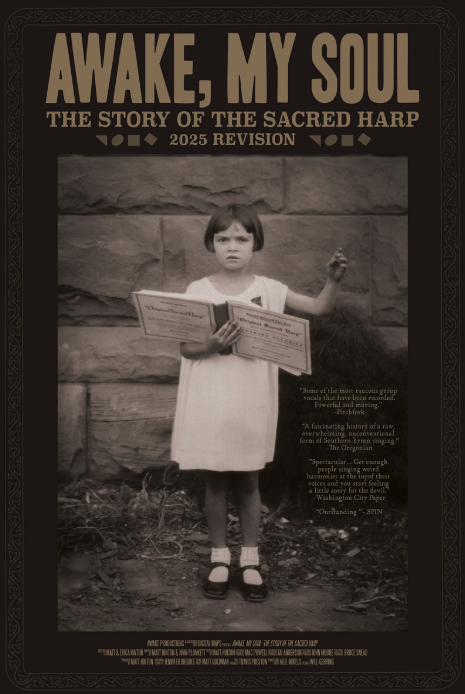
Matt and Erica Hinton's documentary on the tradition in the lede. Watch for the hollow square itself, and notice how long it takes before you realize nobody is conducting.
Layer 02 | Reading trail
- Atul Gawande, "The Checklist Manifesto." Read first. The clearest published version of why the person at the center is the least reliable part of any complex system.
- fasola.org, the Sacred Harp community home. The primary source for the shape-note notation itself, and the singings that still run on it every week.
- Google Design, "Material Design's first 10 years." The internal history of Quantum Paper, from the people who had to fix the fragmentation firsthand.
- McDonald's corporate history, on Hamburger University and QSC&V. The company's own account of the standard Kroc actually built, in its own words.
- GrowthMarketer, "AI-Native Marketing Org Chart for 2026." Read last, and skeptically. It is one practitioner's framework, not settled fact, but it is where the closing exhibit item comes from.
The Studio · Alchemist Inc. · The Dragonfly · No. 03