

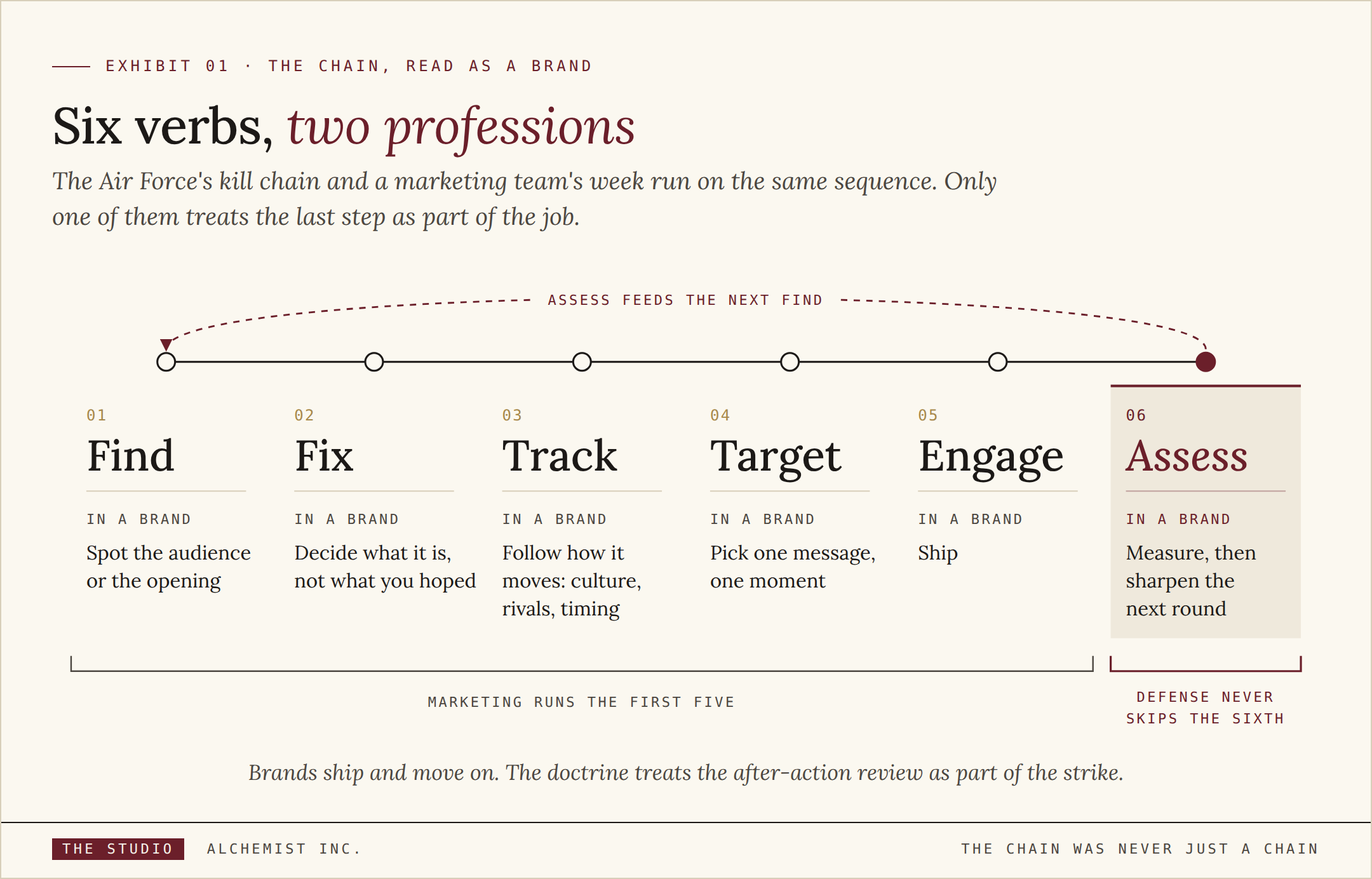
AAn engineer said six words the way you would read out a grocery list. Find, fix, track, target, engage, assess. He was explaining why a piece of hardware needed to talk to five other systems it had never met before test day. I wrote the six words in the corner of my notebook because they sounded like an incantation. "I have spent enough time inside a stealth defence program now to know better than to write down anything specific about what I see there." But a sequence of six ordinary verbs is not a secret. It is the oldest trick in the profession, and it turns out to be a trick I already knew, from a completely different life.

The founder at the head of that table has a problem I recognised immediately. He builds modular defence systems, tiles meant to snap into a larger chain, and almost nothing he makes can be shown in public. He still has to win trust, hire people and raise money. He has to market a product nobody is allowed to see. That is my trade, turned inside out.
The doctrine has a birthday. In the late 1990s, General John Jumper, later the Air Force's Chief of Staff, looked at the gap between spotting a target and putting a weapon on it and decided the gap was the war. The Air Force had an old saying about that gap: under sixty minutes, gotta be good. Under thirty, gotta be lucky and good. Under ten, gotta be crazy. Jumper pushed a six-verb chain, find, fix, track, target, engage, assess, meant to hit ten minutes on purpose instead of by luck. It delivered over Afghanistan in 2001 and again in Iraq in 2003. It became the closest thing modern airpower has to scripture.
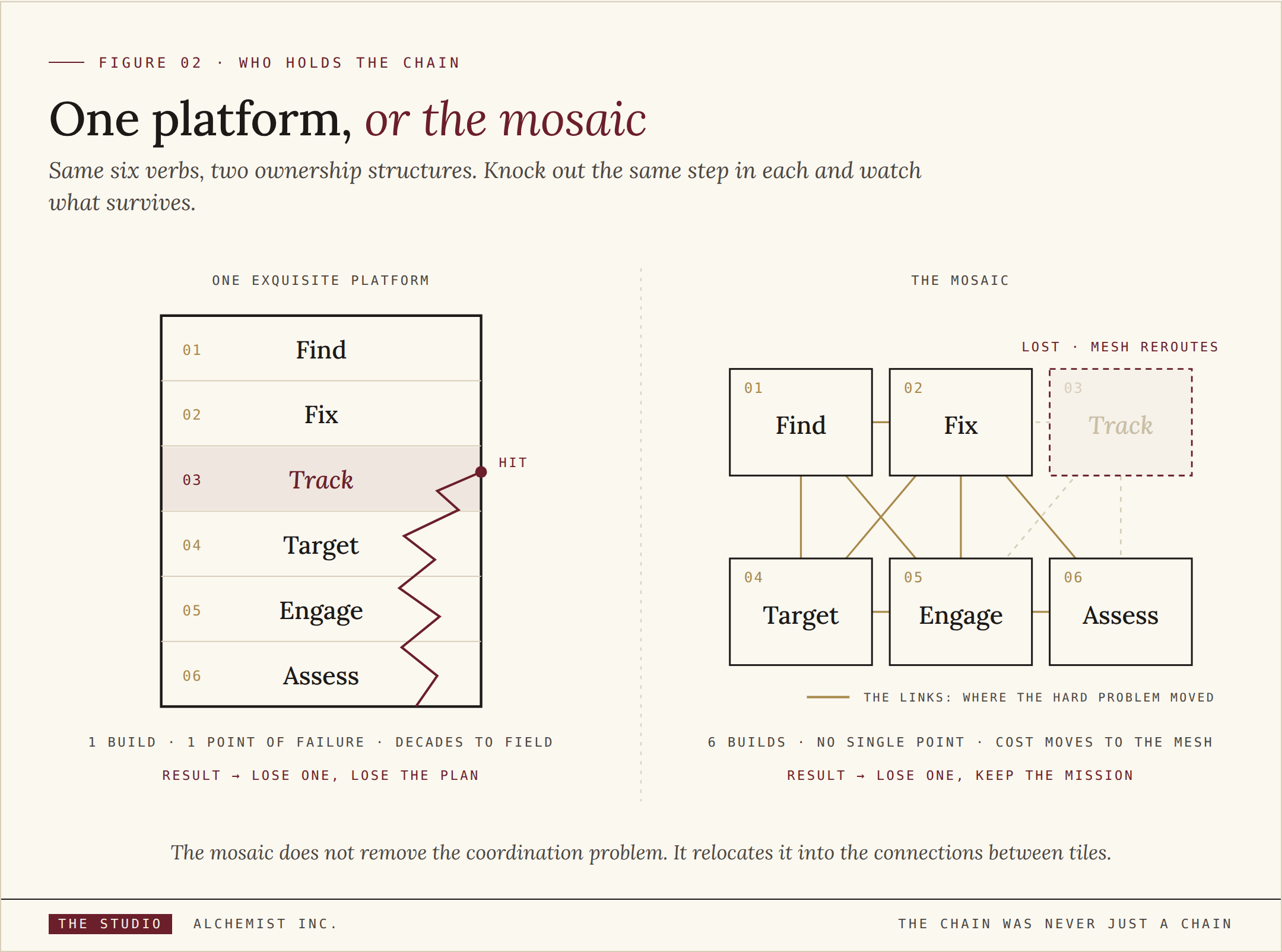
In 2017 and 2018, DARPA's Strategic Technology Office looked at that arrangement and called it a liability dressed as strength. Dan Patt, the office's deputy director at the time, described the alternative in a sentence I have not been able to put down since: the goal was to get many small, cheap, disposable pieces aligned toward a common objective "without perfect communications and without planning everything in advance." They called the approach Mosaic Warfare. Instead of one platform performing find, fix, track, target, engage, and assess end to end, the chain gets pulled apart and handed to a swarm of smaller systems, individually replaceable, that recombine differently for every mission. Lose a tile and the mosaic barely notices. Lose the one exquisite platform and you have lost the plan.
The chain was never just a chain. It was always a description of who is allowed to hold power, and how much of it any single actor is trusted with at once.
The idea is no longer theoretical. This year, Iran's own version of the mosaic, provincial commands built to keep fighting after the center is hit, kept operating through strikes on its leadership. Whatever you make of that war, the design held.
Which brings me back to the founder, and the part of this that is actually my job. When the product is classified, the company has to become the thing on display. Palantir sells a worldview long before anyone sees the software. Anduril sells a stance on how future wars will be fought. Neither is marketing a feature. They are marketing the quality of their thinking, clearly enough that the product is assumed.
Every brand is closer to that position than it likes to admit. Your customer cannot see your process, your margins or your intentions either. What they can see is how you think, in every tile you put out: the post, the deck, the homepage, the way you answer an email. Each one has to land for a stranger who sees nothing else, and still click into the larger chain for someone who sees everything. That is the mosaic, applied to a reputation.
Mosaic Warfare works because every tile, however small, is built to a shared standard that lets it plug into whoever is next to it. A team that disaggregates without that shared standard is not a mosaic. It is six people doing six unrelated things and calling the confusion agility.
I still have the notebook from that room. Six words, handwriting getting worse toward the end because I was writing fast. I recognised my own week inside someone else's doctrine, and some part of me needed proof that the exhaustion of holding a whole process alone was not a personal failing. The fix is building something small enough to lose and clear enough to recombine. I am still working out which of my own six verbs I am willing to hand off first. I no longer think that not knowing yet is the same as not being ready.