

AI is becoming one of the most capital-intensive technologies the world has ever attempted to scale. Behind every model is a semiconductor; behind every semiconductor is a fabrication plant; behind every training run is a cluster of accelerators drawing megawatts of power. Behind those megawatts sits a grid, a transmission network and a power plant. Behind data centres sits another resource that tends to disappear from the conversation: water. We have taken the most abstract capability humans possess - intelligence - and turned it into a massive capital expenditure problem. The numbers make this clear. The International Energy Agency estimates that global data-centre electricity consumption was around 485 TWh in 2025. By 2030, its base case puts that figure at roughly 950 TWh, more than doubling in five years. Electricity consumption from AI-focused data centres is expected to grow even faster, roughly tripling over the same period. Data centres would still account for only around 3% of global electricity consumption by 2030, but the rate of growth is what matters: demand is expected to grow at around 15% a year through the end of the decade.
I. The Capital Loop
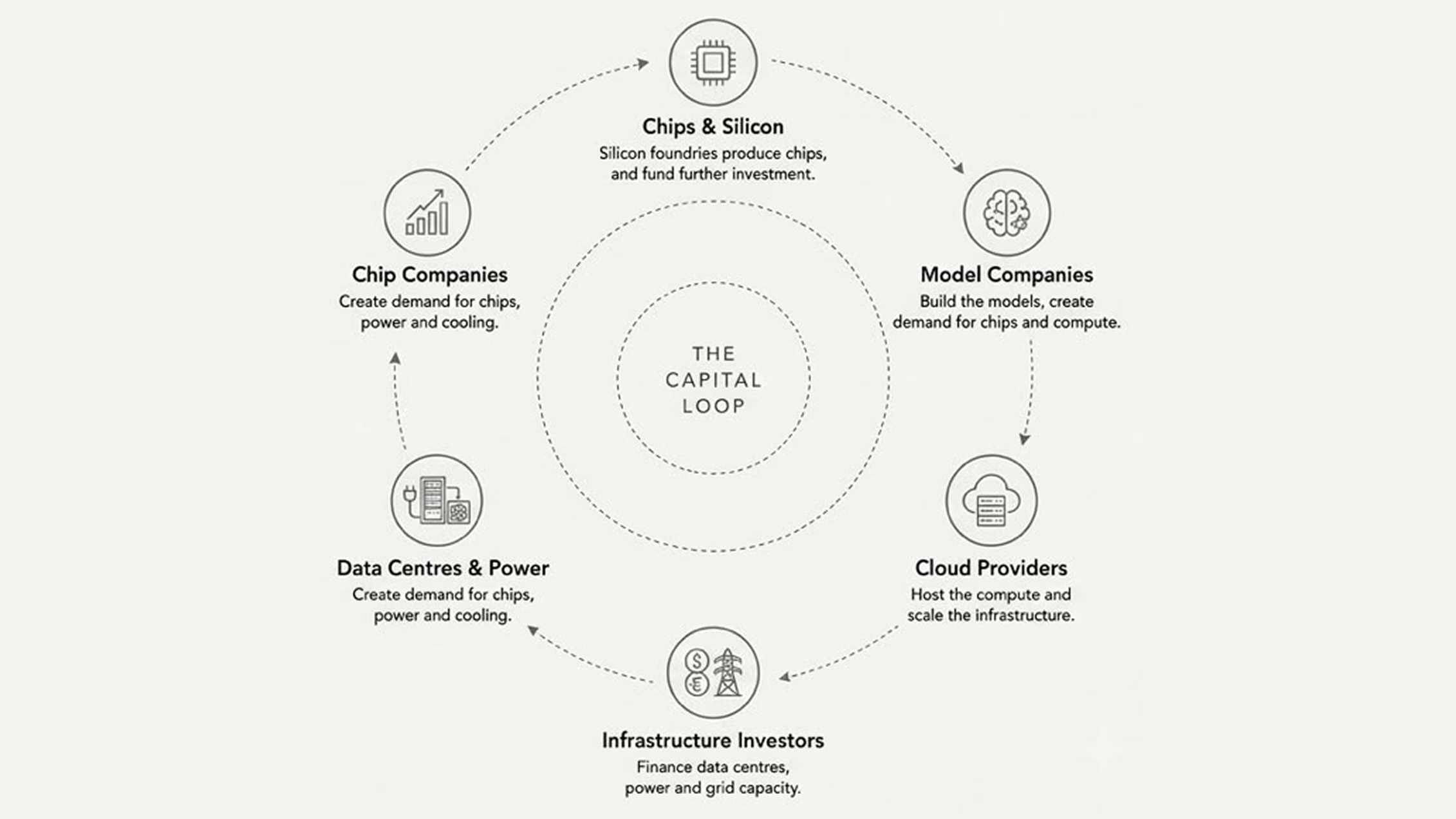
And yet the industry's ultimate destination remains remarkably intangible: artificial general intelligence. There is a point at which technological optimism stops being a product strategy and starts becoming an infrastructure policy. I am not sure we noticed when we crossed it. The most fascinating part of the AI boom is not the technology. It is the money moving around it. Consider the increasingly dense web of relationships forming around OpenAI, NVIDIA and the hyperscalers. In September 2025, NVIDIA announced a strategic partnership under which it intended to invest up to $100 billion in OpenAI, linked to the deployment of at least 10 GW of NVIDIA systems. Then, in February 2026, OpenAI announced another $110 billion of investment at a $730 billion pre-money valuation, including $30 billion from NVIDIA, $50 billion from Amazon and $30 billion from SoftBank. Stargate adds another layer, with hundreds of billions of dollars envisaged for AI infrastructure. The chipmaker finances the model company; the model company buys the chips; cloud providers host the compute; infrastructure investors finance the data centres; data centres create demand for the chips; and chip companies generate the revenues that support further investment. It is not quite a circular transaction. It is something more subtle: capital is increasingly financing the infrastructure expected to create the future demand that will justify the capital. The question, then, is not simply whether the infrastructure will be used. It is whether the future being priced into that infrastructure arrives quickly enough, and at sufficient scale, to justify the economics being built around it.
II. Operating Speed vs Physical Reality
The industry has become fascinated with exponential curves - compute, model capability, user adoption, revenue, and inference. The assumption is that if we keep increasing compute, capability will continue to improve. Perhaps it will. But extrapolation is not economics. For AI, those constraints are increasingly physical: power, chips, grid capacity, cooling, land and capital. A data centre can potentially be brought online in a few years, while the wider energy system often requires much longer planning and construction periods. AI operates at software speed while the energy system moves at infrastructure speed. That mismatch is already reshaping the physical economy. Utilities are planning generation around projected data-centre demand. Developers are securing land based on future power availability. Grid operators are confronting connection requests measured in hundreds of megawatts. Natural gas has acquired a new argument for staying relevant. Nuclear power has suddenly found a customer with an almost bottomless appetite for electricity. Computation produces heat, and heat has to go somewhere. The industry is responding with more efficient cooling systems, but the underlying physics are not negotiable. The more computation performed, the more heat has to be managed, and the resources required to manage it are increasingly part of the economics of AI infrastructure. Efficiency is often presented as the answer. But efficiency changes unit economics; demand determines the aggregate bill. If inference becomes 90% cheaper, the likely market response is not restraint but greater usage. Computing became cheaper, and we used more computing. The same could happen with AI. There is another problem: an AI data centre is not an infinitely useful asset. The economics of a frontier GPU cluster depend not only on what it costs to build, but on how long that compute remains economically competitive. Today's most advanced hardware can become tomorrow's depreciating asset while the industry is still paying for the building that houses it. That makes utilisation critical. The industry can build the capacity. The harder question is whether the world can generate enough economically valuable workloads to consume it.
III. The AGI Option Value
Today's AI creates real value. We do not need AGI to justify AI. The addressable market for conventional AI is largely the existing market for software and computing. The potential market for AGI is much larger because it begins to overlap with human cognitive labour. If machines can perform a sufficiently broad range of economically useful cognitive tasks, the opportunity is no longer simply to sell better software. It is to substitute, complement or augment a significant portion of the world's intellectual labour. If you believe AGI is five years away, a $100 billion infrastructure commitment can look remarkably small against the potential value created. If you believe it is twenty years away, the economics look different. If you believe today's scaling approaches cannot get there at all, they look different again. This is where the conversation around AI becomes less about what the technology can do today and more about what we believe it will eventually be able to do. We know models are improving. We know scaling has produced remarkable capabilities. But capability is not necessarily generality. Human intelligence involves transfer, abstraction, causal reasoning, and context - including the ability to recognise that the technically correct answer can sometimes be the wrong answer. Suppose models continue improving, inference becomes dramatically cheaper, and productivity rises substantially, but the curve eventually flattens. AI becomes extraordinarily capable, but never genuinely general. Would the infrastructure still have been worth building? This is not an argument against AI. It is an argument against treating the economic value of AGI as though it were already sitting on a balance sheet.
“It is an option - a potentially extraordinarily valuable option, but an option nonetheless.”
IV. Productivity, Dependency and the Return
Railways were real. The internet was real. Telecommunications were real. All of them changed the economy, yet investors still managed to pay too much for the companies building them. A technology does not have to be fake for the financial expectations surrounding it to become excessive.
AI sits unusually close to the act of thinking itself. It does not simply retrieve or calculate; it synthesises, writes and argues. If an employee never has to write a first draft, construct an argument, or struggle through a difficult problem, the technology may make the immediate task faster without necessarily increasing the worker's underlying capability.
That distinction matters because productivity is not simply how much work gets produced. It is how much valuable output is produced relative to the resources required to produce it.
If AI allows one employee to do the work of three, that is a productivity gain. If it allows three employees to produce the work of one, it is not. And if it makes the economy increasingly dependent on vast amounts of capital, electricity, and hardware to perform tasks that previously required comparatively little physical input, the calculation becomes even more complicated.
The economic significance of AI will not be determined solely by how intelligent the models become. It will depend on whether the economic value created by that intelligence grows faster than the cost of producing it.
Not whether AI is useful - it clearly is - but whether the economic surplus generated by increasingly powerful AI is large enough to justify the extraordinary capital being committed to produce it.
Because perhaps the real question is not whether we can build machines that think. It is whether the economics of building them can keep up with our ambition for what they might become.
In Closing,
I am 21, and in the short time I have spent working, I have moved from real-estate transactions at ANAROCK to Alchemist, a creative agency built around the intersection of creativity and technology. On paper, the two could hardly seem more different. But working in the land vertical taught me something that I had not really thought about before: how capital-intensive growth can be. Land, infrastructure, approvals, construction, and financing all have to come together before an idea can become something physical.
AI is beginning to make that same idea feel strangely familiar, except at a different scale.
We often talk about AI as though it exists almost entirely in the digital world. In reality, some of the biggest bets being made on it are increasingly physical. Data centres, semiconductors, power generation, cooling systems, land and the infrastructure required to connect all of it. We are taking something as intangible as intelligence and building an enormous physical economy around it.
And yet, on the other side of that infrastructure, the experience for most of us is remarkably simple.
I use AI to build decks and financial models, research projects and markets, organise work and, sometimes, simply get past the blank page. Across an ordinary working day, it probably gives me back an hour or two. I suspect that is true for millions of people in ways both much bigger and much smaller than mine. The efficiency is real. The convenience is real. The value is real
Which makes the question more interesting, not less.
What does it cost?
The answer that appears on my screen in seconds still requires chips, data centres, electricity, cooling, water, land and capital. And as the cost of intelligence falls, usage is likely to rise. What is efficient for one person can become enormously resource-intensive when multiplied across billions of people.
That is where efficiency becomes an opportunity-cost question. If AI saves us time, what are we spending to save it - and what else could those resources have produced?
I still want AI to become better. I still want it to become cheaper. And perhaps that is precisely why the question cannot be ignored. The more useful AI becomes, the more of it we will use.
The economic significance of AI, then, may not be determined simply by how intelligent the models become. It may depend on whether the value created by that intelligence grows faster than the physical and financial resources required to produce it.
At some point, progress stops being measured only in benchmarks and starts being measured in gigawatts. A model stops being just software and becomes a reason to build a power plant.
“The world does not owe us AGI because we spent enough money trying to build it.”
And if, after all the GPUs, gigawatts, financing rounds and billions of prompts, machines become extraordinarily good at thinking while humans become extraordinarily dependent on them to do it, there will be one rather awkward question left:
Who, exactly, got smarter?