
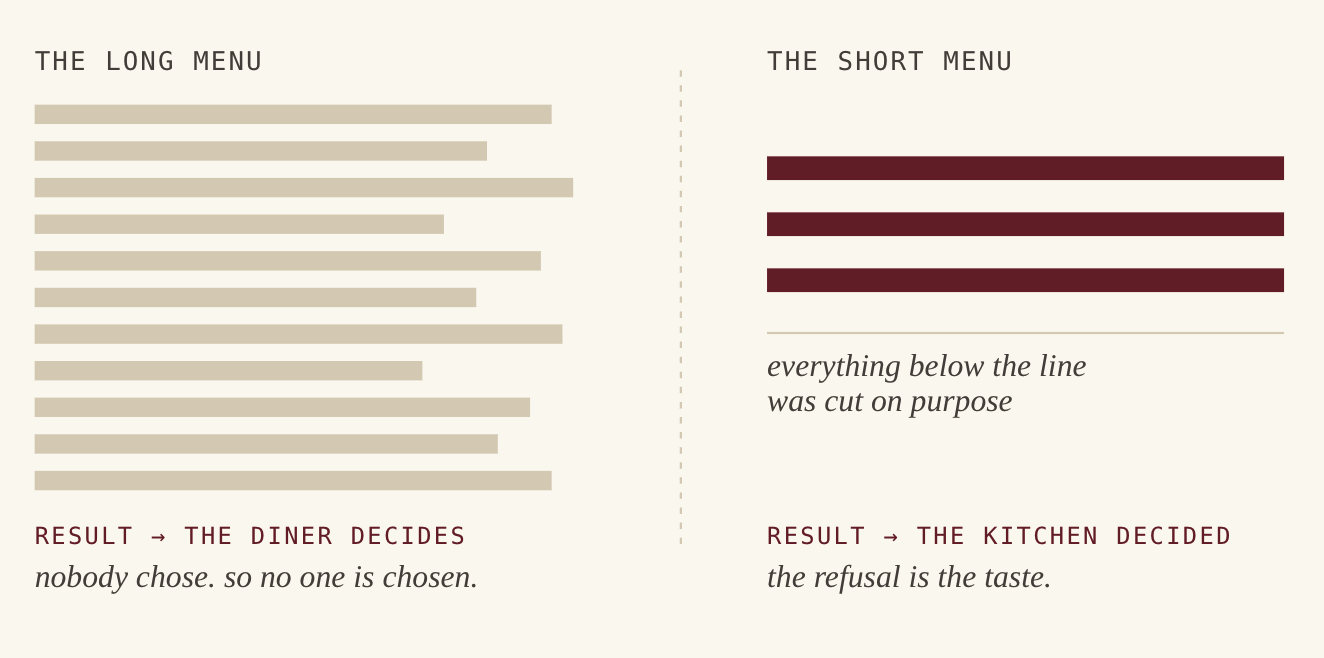
There is a restaurant near a station I used to pass, and its menu was eleven laminated pages. Pasta on page three. Biryani on page six. A photograph of a milkshake that had clearly been photographed somewhere else. You could get a burger, a thali, a sizzler, a chowmein, a dosa, and something the menu called "Chinese Bhel." It wanted to be everything to everyone who might walk in. I never once saw it full.
The obvious reading is that the food was bad. Maybe it was. But a kitchen that cooks forty things cannot be good at forty things, and everyone at the table knows it, which means the menu had already told you the truth before the first plate arrived. The length was the message. Eleven pages is not generosity. Eleven pages is a restaurant that could not decide what it was, asking you to decide for it.
A menu looks like a list. It is not a list. A menu is an argument about what you should want. Every item on it is a claim: this belongs here, this is worth your evening, this is what we are. And every item left off is the harder claim, the one that costs something: this is not us. The short menu is not the lazy menu. It is the one where someone did the expensive work of deciding.
Now leave the restaurant, because this was never about food.
I run an agency. People come to us the way they come to any agency, holding a thing they are certain is a product. Usually it is not a product. Usually it is an opening.
They have noticed a gap in a market, a hole where a thing should be, and the noticing feels so much like an idea that they mistake one for the other. An opening is a bet that the hole exists. A product is the thing that fills it. Between those two is all the work, and the work is not the part anyone wants to talk about in the first meeting.
So they ask us to market it. And here is the quiet thing about our trade that no pitch deck says out loud.
“Marketing can only buy mileage on an engine that already runs. ”
We can get a good product in front of more people, faster, in better light. We cannot make a bad product good on the way to the customer. We do not polish your production line. We do not fix the thing itself. If the burger is wrong, no amount of beautiful photography of the burger will save you. It will only get more people to try it once.
This is the part founders find hardest to hear, because it sounds like we are refusing the job. We are not. We are naming which job is actually ours. The most honest sentence an agency can say is also the least sellable one: we cannot save a product that has not decided what it is. But sitting underneath that refusal is the thing we can do, and it is the only thing that was ever scarce. We can tell you what your opening is actually worth. We can look at your eleven laminated pages and say the sentence you hired everyone around you not to say. Cut nine of these. This one. Only this one.
That is taste. Not decoration, not a mood board, not a font. Taste is the act of deciding what belongs and what does not, made by someone with the stake to be wrong about it. In a world where everyone can execute, where the tools are cheap and the tutorials are free and anyone can make the thing, execution stopped being the scarce part. The deciding is the scarce part. The one who knows what to leave off the menu is worth more than the ten who know how to cook.
Every founder I have ever met wants to add the chicken. There is always a chicken. There is always the customer who asked for it, the two people in the crowd of a hundred who would come if only you also did this one more thing. Adding it feels like ambition. It is almost always the opposite. It is the refusal to decide, dressed up as generosity, and the crowd of a hundred can feel it. They walk into a restaurant that will cook anything and they order nothing, because a kitchen that will make everything has quietly admitted it is sure of nothing.
The senior people understand this, which is why you can watch it happen as someone rises. Early in a career, design is decoration, marketing is noise you buy, and the product is the "real" work happening somewhere else. Later, if they are any good, it inverts. They start to see that the design was the decision, that the taste to cut nine dishes is not softer than the engineering, it is the harder-won thing, and that it shows up directly in the revenue. A brand is a promise the product then has to physically keep. Getting the promise right is not the fluffy part of the business. It is the part the rest of the business is trying to earn out.
· · ·
I think about that station restaurant more than it deserves. Eleven pages, and a photograph of a milkshake that belonged to someone else's kitchen. It was not that they had bad taste. It was that they had refused to use any. They had declined the one job that was fully theirs, the deciding, and handed it to whoever happened to sit down, and then wondered why nobody stayed.
The founders who make it are not the ones with the most on the menu. They are the ones who did the expensive, lonely, unglamorous work of leaving things off. Marketing can carry that decision further than it would travel on its own. It was never able to make the decision for you. A menu is an argument about what you should want. The good ones are short because someone already had the taste to lose every argument but one.
-----------------------------------------------------------------------------------------------------------------
Layer 2 || Reference Clips
-----------------------------------------------------------------------------------------------------------------
Layer 3 || Reading trails
- Cornell & the Illinois menu-labeling studies. The hard numbers: trimming a menu can lift profit 10–15%, and a described item can outsell its neighbours by a quarter. The taste is measurable.
- Stacy Perman, "In-N-Out Burger." Where the Harry Snyder refusals are documented in full. Read for the pattern, not the burgers.
- Michael Porter, "What Is Strategy?" The canonical version of the whole piece: strategy is choosing what not to do. Read last, to see the menu argument as an old law wearing an apron.